A close-up can describe a connector, but it can leave the surrounding harness almost invisible. For a parts enquiry, the route of the sleeved runs, the places where they branch and the arrangement of their visible ends provide a different kind of information. Two independent field photographs show why this wider view deserves its own place in a record. Their value lies in visible layout, rather than in treating every plug as a separate product photograph.
Start with the visible route
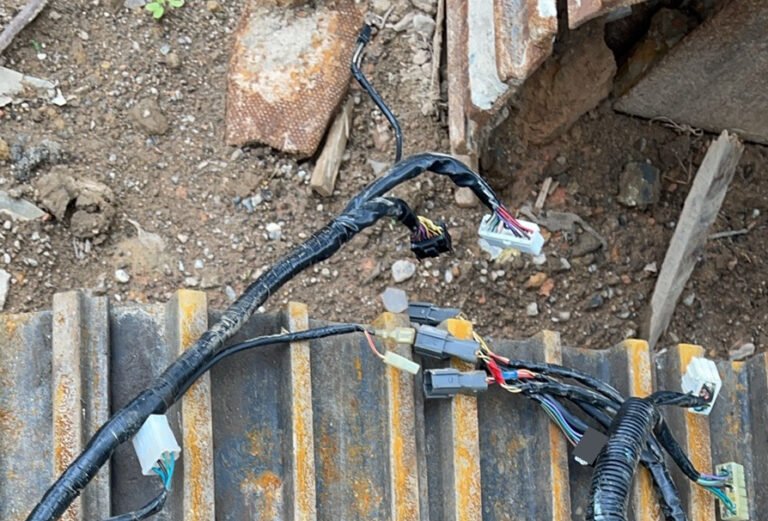
The first example shows a curved run of protective sleeving and several branches resting across track plates. Shorter runs and connector bodies appear around the upper and right-hand parts of this selected view. The visible route leads the eye toward individual ends, although this crop does not show the entire assembly. The track plates are the background on which the item was photographed; they do not establish where the harness belongs on a machine.
For an enquiry image, this overall relationship matters. A tight crop around one end may remove the point at which its branch joins the wider layout. Describe the visible run and its branch position together: for example, a shorter sleeved branch near a group of connector bodies. That is more useful than an isolated description such as “the white plug,” especially when similar housings appear more than once.
Keep overlaps visible
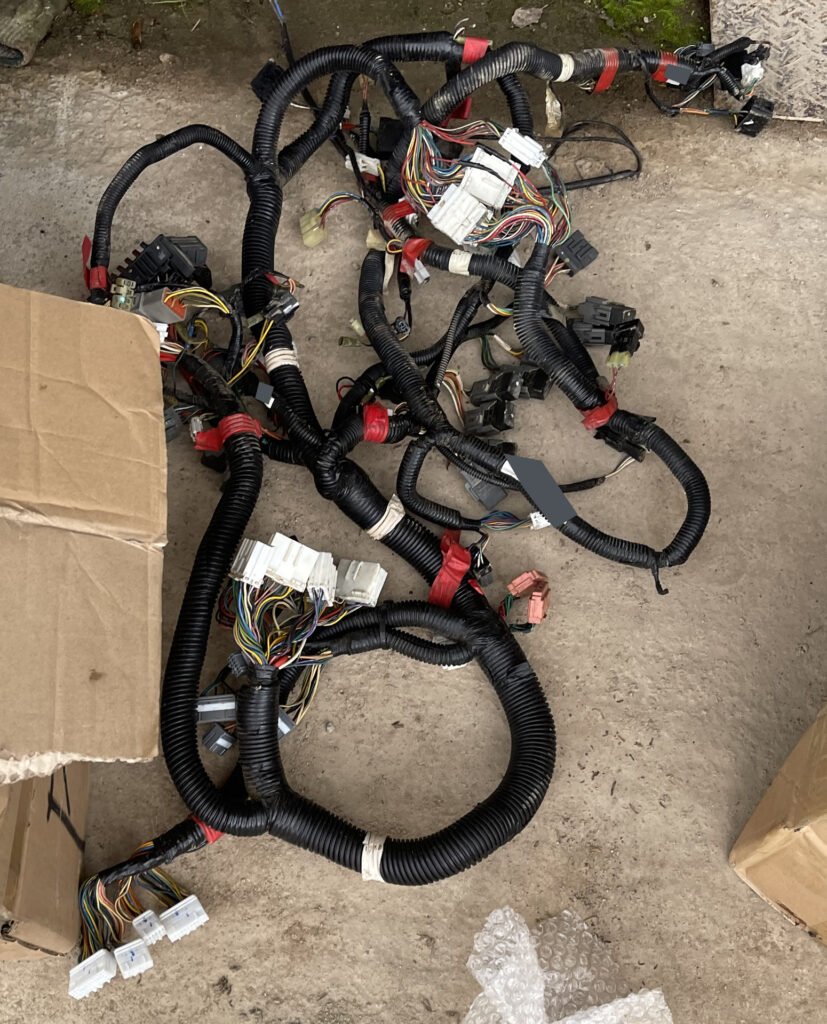
The second example has a more compact arrangement, with several curved sleeved runs, gathered wires and connector groups visible on the ground. Some runs pass across or beside others. Those overlaps make the photograph useful as a record of the arrangement in view, but they also make it harder to follow every route from one end to another. An apparent crossing should not be silently treated as a branch junction.
In a parts enquiry, identify which visible section you mean without filling in an obscured route. Refer to its position in the photograph, a nearby sleeved curve or a clearly visible group of ends. If a relationship cannot be followed in the image, describe it as unclear. A second photograph can be requested when that missing relationship matters to the enquiry.
Give the overview and the detail different jobs
An overall view helps another person locate the requested area. A closer image can then record a particular branch junction, sleeving transition or visible end. When both views are confirmed to show the same harness, keep a common reference feature in them where possible, so the reader can understand which area has been enlarged. This complements connector-face photography rather than replacing it.
Neither photograph includes a measurement scale. Perspective, curved runs and hidden sections prevent reliable length estimates from the image alone. When a dimension is needed, request a separate measurement record that identifies the feature, reference points and units. Do not turn spacing on the screen into a supplied specification.
Build a clearer enquiry record
Keep independently verified part references separate from observations about the photographs. Say which assembly or section you are asking about, which relationship is visible and which additional view is needed. A cropped view can answer a local layout question without pretending to show every end or the full assembly.
These independent field examples support layout documentation for an enquiry; they do not establish an electrical connection plan, interchangeability or a repair result.
Questions and Answers
What does an overall harness photograph add to a connector close-up?
It shows the visible route, branch positions and arrangement of ends. A close-up can then describe a selected area without losing its place in the wider view.
Does one run crossing another prove they form a branch junction?
No. A photograph may show an overlap without revealing how the runs relate. Keep that relationship unconfirmed when it cannot be followed visually.
Can harness length be estimated from these photographs?
Not reliably. There is no measurement scale, and curves, perspective and hidden sections affect the apparent length. Request a separate record with identified reference points and units.
Do the two examples show one harness before and after work?
They are independent field examples. No before-and-after relationship, shared machine identity or repair sequence is established.
Does a selected branch view show the entire harness?
Not necessarily. A crop can show a useful local relationship while excluding other runs and ends. Identify it as a selected view, and request a fuller record when the overall assembly is needed.