Repeating lines do not always describe the same kind of structure. A spring has visible spaces between its turns; a cylindrical metal body can carry closely spaced grooves across a continuous exterior. Two EexcavaStart field details bring those differences into view, together with the broader changes in outline at the ends.
Space between the coils
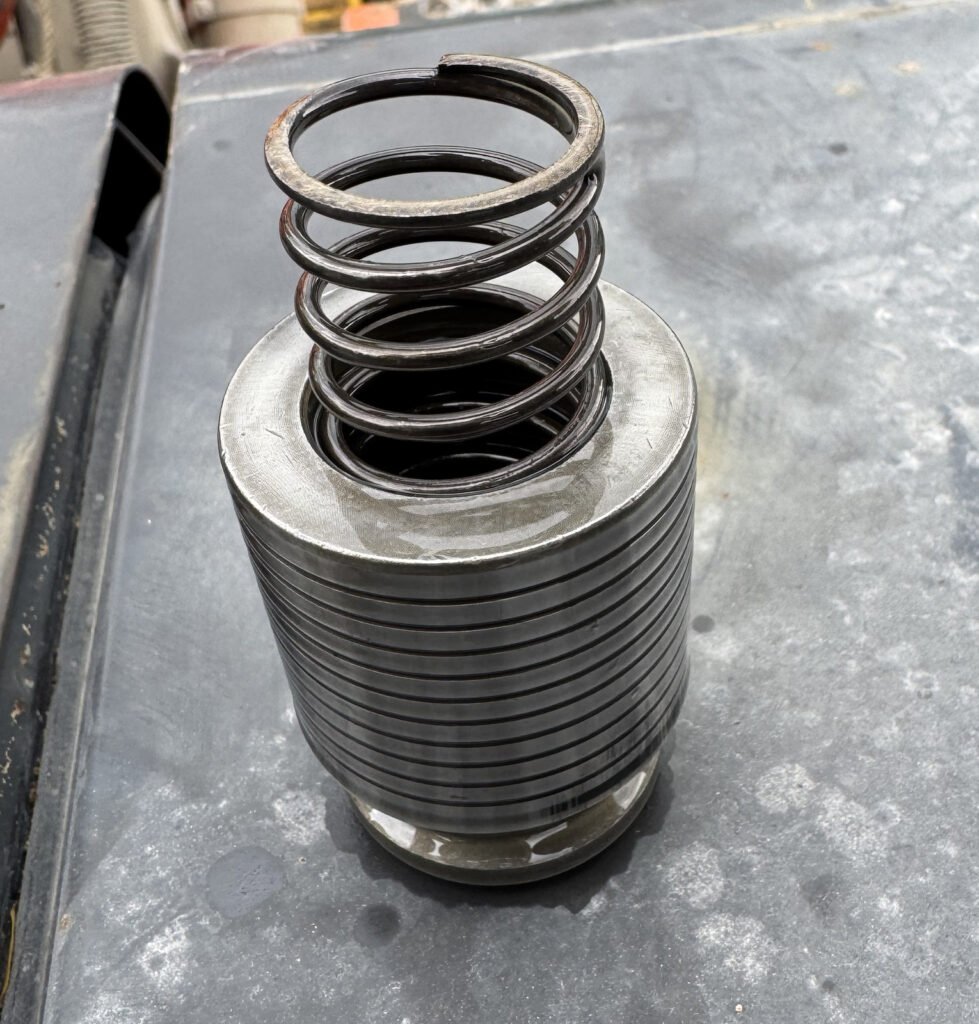
In the first photograph, a dark spring rises above a circular opening. The work surface can be seen through the spaces between its upper turns. A broad, bright rim surrounds the opening below it, followed by a darker cylindrical body with many closely spaced lines around its outside.
The spring and the body both produce a repeated pattern, but their silhouettes behave differently. The spring’s upper outline is open between turns. The body’s sides remain continuous, with the grooves appearing as narrow bands across that surface. This distinction is visible without assigning an internal function to either feature.
The shoulder changes the outline
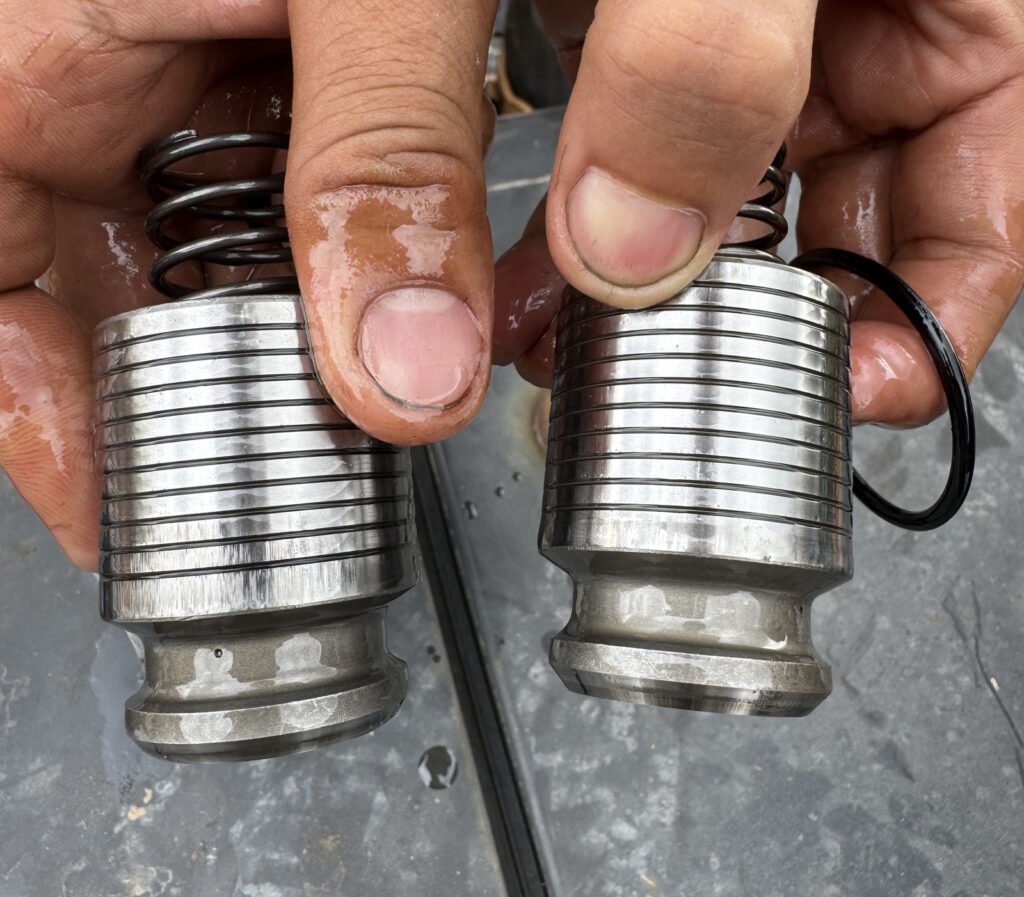
A separate hand-held view shows two banded metal bodies beside one another. Each has a broad upper section and a narrower region near its lower end, followed by a wider lip. These changes in outline remain visible even where fingers cover part of the upper surface.
The lower neck and lip add information that the repeated grooves alone cannot carry. They locate a change in diameter along the body rather than simply adding another line to its surface. A dark loose ring appears beside the right-hand example; its presence does not identify a groove it belongs in or establish an assembly order.
A close view, not a parts sequence
The photographs support a distinction between open coils, surface grooves and a stepped exterior profile. They do not establish that the examples belong to one assembly, that the two hand-held items form a matched pair, or that any loose part has a confirmed installation position.
These records preserve the real surfaces, including marks and reflections. Exact identities, dimensions and the form or purpose of the grooves remain open. For a parts conversation, the useful gain is a more specific description of what is visible, rather than treating every repeated line as the same feature.
Spring Coils and Banded Bodies: Questions and Answers
What visibly separates the spring from the banded body?
There are open spaces between the spring turns, while the cylindrical body presents a continuous outer surface with closely spaced grooves. These are different visible structures, not interchangeable descriptions.
Do the repeated grooves identify a thread form or a component function?
No. Their visible position can be described, but the photographs do not establish a thread standard, measured profile or internal purpose.
What does the narrower lower region add to the record?
It shows a change in the external outline between a broader body and a wider lower lip. That stepped profile is a separate feature from the repeated surface grooves.
Are the two hand-held items and the loose ring a documented parts set?
No matched set or installation order is established. They share a visible frame, but their exact identities and relationship remain unconfirmed. The two photographs are not presented as a repair sequence.
Related reading: Hydraulic Parts Records: Assemblies, Ports and Connections. Browse News & Insights.